
FLOW HFM complex for processing retted stalks of industrial hemp


FLOW HFM (Hemp Fiber Machines) — a complex for processing retted stalks of industrial hemp is designed for the production of single-type fiber from industrial hemp (retted hemp stalks).
The complex processes raw material in the form of shaped bales of rectangular shape (bales) or cylindrical shape (round bales) from hemp stalks with chaotic arrangement of hemp in the layer.
As a result of raw material processing in the FLOW HFM, pure fiber and shives are obtained.
| Performance specifications | ||
|---|---|---|
| Parameter name | Parameter value | |
| Type of equipment | agricultural processing | |
| Raw material for processing | retted hemp stalk | |
Permissible dimensions of raw material in the form of a rectangular bale of retted hemp stalks:
|
|
|
Permissible dimensions of raw material in the form of a round bale of retted hemp stalks:
|
|
|
| Raw material output, kg/hour | 700 – 800 | |
| Fiber output, kg/hour | 250 – 300 | |
| Shives content in fiber, %, not more | 3 | |
| Number of service personnel, persons, not less |
3 | |
| Required air flow rate in dust removal system, m3/hour, not less | 24000 | |
| Rated power of electrical consumers of the Complex, kW | 88,5 | |
Power supply:
|
|
|
| Degree of protection provided by the enclosures of electrical equipment against environmental influences | Ip54 | |
| Protection class against electric shock | 01 | |
Overall dimensions, mm, not less:
|
|
|
| Mass, kg, not less | 22000 | |
Note.
The given characteristic meanings can be ensured under the following conditions:
1. The raw material is the retted hemp stalks, which were harvested by spring harvesting technology and has undergone maceration by dew retting.
2. The humidity of the raw material must be no more than 16 %.
General view of the FLOW HFM (Hemp Fiber Machines) complex
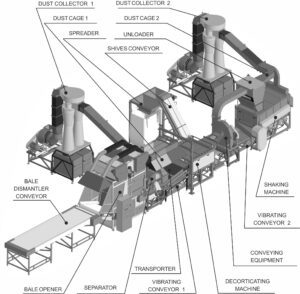
The processing of raw material in the FLOW HFM is carried out as follows: a bale or round bale of raw material formed in the field from hemp stalks is placed onto the conveyor of the bale opener using any lifting and transport means, such as an electric forklift truck. The bale or roll then enters the working chamber of the bale opener, where the raw material is loosened and a continuous feed strip is formed for further processing.
At the same time, as a result of raw material decompaction, heavy foreign objects (stones, metal objects, small pieces of land, etc.) are separated from the main flow with the help of a pneumatic separator and accumulated in the appropriate container.
Then the belt enters the separating device, where shives separated at the preliminary operation atr separated through a sieve and poured onto a vibrating conveyor. The fiber with the residual shives are conveyed by means of a transporter to the decorticating machine.
In the decorticating machine the belt is subjected to braking by fluted rollers, which leads to intensive separation of shives from the fiber, which are also poured onto the vibrating conveyor 1 and moved to the shive conveyor.
The layer of fibrous raw material after the decorticating machine is conveyed to the shaking machine by means of a conveying equipment.
The fiber mass is transported with a considerable volume of air, therefore a unloader is installed before the shaking machine. In the unloader the air flow speed is sharply reduced and the fiber mass falls on the needle field of the shaking machine, where the final cleaning of fiber from shive residues takes place, thus the separated shive with insignificant amount of fine fiber is poured out on the vibrating conveyor 2 and is transported to the shive conveyor.
The shive conveyor moves the separated shive into Big Bag bags attached to the spreader.
After the shaking machine, the fiber is accumulated for further packaging and storage.
During raw material disassembly, roughing and final cleaning of the fiber a considerable amount of dust is generated, therefore dust collectors 1 and 2 are installed in the respective areas and are connected to dust cages 1 and 2 respectively. The dust is collected in removable dust collector containers and the cleaned air is discharged to the environment outside the room.
Dust collectors can be optionally equipped with an aspiration unit, which enables fine cleaning (regeneration) of air from dust and retains it inside the room. The FLOW HFM complex can also be additionally equipped with presses for fiber and shives, with either manual or automatic strapping of finished bales.
1. Types of obtained products.
The processing of raw materials results in 2 types of products:
– purified fiber with shives content not more than 3 %. Fiber – large fragments of different length and linear density. Fiber output is 32 %.
– pure shives. Output – 68 %. Particle size of the shives – 10-150 mm. This product contains small fragments of fiber in an amount of less than 3 % of the total mass of the raw material.
All values are based on the initial fiber/shives ratio in the feedstock – 35 / 65.
2. Maintenance.
Delivery and stacking of bales on the working surface of the first machine of the Complex is provided by a standard forklift.
The finished product is collected in Вig Bag bags and other storage capacities.
The minimum number of service personnel is 3 persons. In this case, 1 person is involved in bale stacking on the conveyor of the first machine, and 2 persons – in the gathering of finished products.
3. Space requirements.
To install and maintain the equipment, a flat concrete floor with an area of at least 350 m² (dimensions 28 × 12.5 m) is required.
In the room it is necessary to organize the power cable supply and install supply and exhaust ventilation* to remove exhaust air from the room, focusing on the total power of electrical consumers and the required air flow.
* Optionally, it is possible to equip with an autonomous aspiration unit, in which case the exhaust air is cleaned (regenerated) from dust and remains in the room.
- High purity of the obtained fiber.
- Simple operation and construction.
- No need for adjustment and customisation during operation.
- Increased durability and reliability.
About the product
FLOW HFM (Hemp Fiber Machines) — a complex for processing retted stalks of industrial hemp is designed for the production of single-type fiber from industrial hemp (retted hemp stalks).
The complex processes raw material in the form of shaped bales of rectangular shape (bales) or cylindrical shape (round bales) from hemp stalks with chaotic arrangement of hemp in the layer.
As a result of raw material processing in the FLOW HFM, pure fiber and shives are obtained.
Characteristics
| Performance specifications | ||
|---|---|---|
| Parameter name | Parameter value | |
| Type of equipment | agricultural processing | |
| Raw material for processing | retted hemp stalk | |
Permissible dimensions of raw material in the form of a rectangular bale of retted hemp stalks:
|
|
|
Permissible dimensions of raw material in the form of a round bale of retted hemp stalks:
|
|
|
| Raw material output, kg/hour | 700 – 800 | |
| Fiber output, kg/hour | 250 – 300 | |
| Shives content in fiber, %, not more | 3 | |
| Number of service personnel, persons, not less |
3 | |
| Required air flow rate in dust removal system, m3/hour, not less | 24000 | |
| Rated power of electrical consumers of the Complex, kW | 88,5 | |
Power supply:
|
|
|
| Degree of protection provided by the enclosures of electrical equipment against environmental influences | Ip54 | |
| Protection class against electric shock | 01 | |
Overall dimensions, mm, not less:
|
|
|
| Mass, kg, not less | 22000 | |
Note.
The given characteristic meanings can be ensured under the following conditions:
1. The raw material is the retted hemp stalks, which were harvested by spring harvesting technology and has undergone maceration by dew retting.
2. The humidity of the raw material must be no more than 16 %.
Structure
General view of the FLOW HFM (Hemp Fiber Machines) complex
The principle of action
The processing of raw material in the FLOW HFM is carried out as follows: a bale or round bale of raw material formed in the field from hemp stalks is placed onto the conveyor of the bale opener using any lifting and transport means, such as an electric forklift truck. The bale or roll then enters the working chamber of the bale opener, where the raw material is loosened and a continuous feed strip is formed for further processing.
At the same time, as a result of raw material decompaction, heavy foreign objects (stones, metal objects, small pieces of land, etc.) are separated from the main flow with the help of a pneumatic separator and accumulated in the appropriate container.
Then the belt enters the separating device, where shives separated at the preliminary operation atr separated through a sieve and poured onto a vibrating conveyor. The fiber with the residual shives are conveyed by means of a transporter to the decorticating machine.
In the decorticating machine the belt is subjected to braking by fluted rollers, which leads to intensive separation of shives from the fiber, which are also poured onto the vibrating conveyor 1 and moved to the shive conveyor.
The layer of fibrous raw material after the decorticating machine is conveyed to the shaking machine by means of a conveying equipment.
The fiber mass is transported with a considerable volume of air, therefore a unloader is installed before the shaking machine. In the unloader the air flow speed is sharply reduced and the fiber mass falls on the needle field of the shaking machine, where the final cleaning of fiber from shive residues takes place, thus the separated shive with insignificant amount of fine fiber is poured out on the vibrating conveyor 2 and is transported to the shive conveyor.
The shive conveyor moves the separated shive into Big Bag bags attached to the spreader.
After the shaking machine, the fiber is accumulated for further packaging and storage.
During raw material disassembly, roughing and final cleaning of the fiber a considerable amount of dust is generated, therefore dust collectors 1 and 2 are installed in the respective areas and are connected to dust cages 1 and 2 respectively. The dust is collected in removable dust collector containers and the cleaned air is discharged to the environment outside the room.
Dust collectors can be optionally equipped with an aspiration unit, which enables fine cleaning (regeneration) of air from dust and retains it inside the room. The FLOW HFM complex can also be additionally equipped with presses for fiber and shives, with either manual or automatic strapping of finished bales.
Features
1. Types of obtained products.
The processing of raw materials results in 2 types of products:
– purified fiber with shives content not more than 3 %. Fiber – large fragments of different length and linear density. Fiber output is 32 %.
– pure shives. Output – 68 %. Particle size of the shives – 10-150 mm. This product contains small fragments of fiber in an amount of less than 3 % of the total mass of the raw material.
All values are based on the initial fiber/shives ratio in the feedstock – 35 / 65.
2. Maintenance.
Delivery and stacking of bales on the working surface of the first machine of the Complex is provided by a standard forklift.
The finished product is collected in Вig Bag bags and other storage capacities.
The minimum number of service personnel is 3 persons. In this case, 1 person is involved in bale stacking on the conveyor of the first machine, and 2 persons – in the gathering of finished products.
3. Space requirements.
To install and maintain the equipment, a flat concrete floor with an area of at least 350 m² (dimensions 28 × 12.5 m) is required.
In the room it is necessary to organize the power cable supply and install supply and exhaust ventilation* to remove exhaust air from the room, focusing on the total power of electrical consumers and the required air flow.
* Optionally, it is possible to equip with an autonomous aspiration unit, in which case the exhaust air is cleaned (regenerated) from dust and remains in the room.
Advantages
- High purity of the obtained fiber.
- Simple operation and construction.
- No need for adjustment and customisation during operation.
- Increased durability and reliability.
Video
Key Advantages
High purity of
the obtained fiber
Simple operation
and construction
No need for adjustment
or tuning during operation
Increased durability
and reliability
Warranty service during
12 months

Commissioning works

Customer personnel training

Post-warranty service

Author’s supervision over the equipment